Main course · Peru, from the wok
Lomo saltado
Lomo saltado is a Peruvian stir-fry of tenderloin strips, red onion, tomato and ají amarillo with soy sauce and vinegar, served with French fries and white rice; its roots are Chinese-Peruvian (chifa). The wok runs at full heat for a few minutes, so the onion stays crisp and the tomato only softens at the edges.
At a glance
- Origin
- Peru (Lima); Chinese-Peruvian cooking
- Cut
- Tenderloin (lomo fino); sirloin or rump
- Key flavours
- Soy sauce, vinegar, ají amarillo, cumin
- Serves
- 4
- Time
- 50 min, of which 5 min in the wok
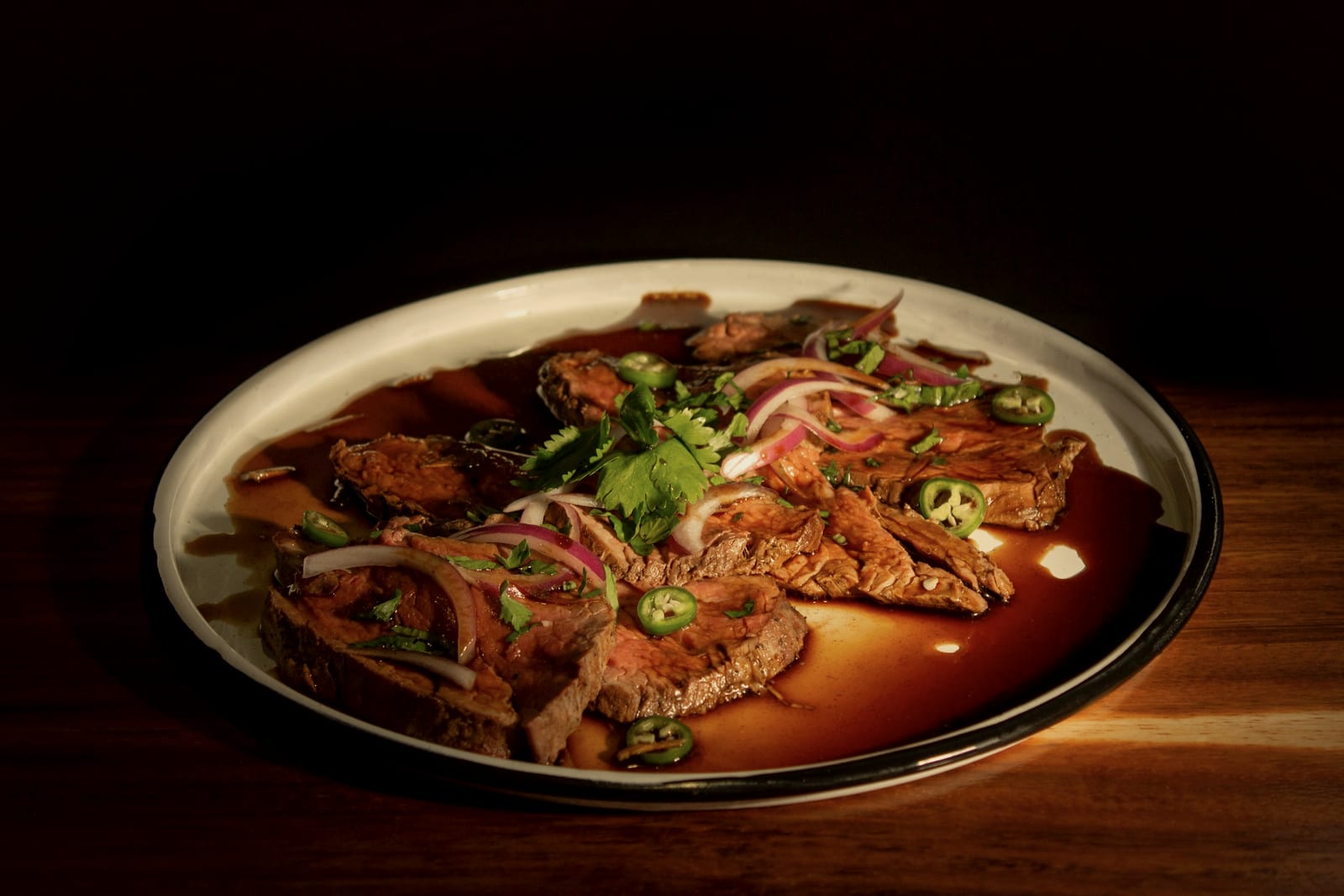
Seared, tossed, done in minutes
Lomo saltado means "sautéed loin": the Spanish saltear, to sauté, comes from saltar, to jump, the movement of food tossed in a pan. Strips of beef are seared in a wok over the highest possible heat, then tossed with wedges of red onion and tomato, strips of yellow chile and a splash of soy sauce and vinegar. The whole cooking takes a few minutes; the onion stays crisp and the tomato only softens at the edges.
The plate pairs two staples: fried potatoes, from the Andes, and white rice, from Asia. The fries are either tossed in at the end to soak up the juices or served alongside so they stay crisp. It is one of the most common dishes in Peru, served in home kitchens, in neighbourhood restaurants (menús) and in formal dining rooms.
Cantonese labourers and Lima's eating houses
Between 1849 and 1874 roughly 100,000 Chinese labourers, most of them Cantonese, were brought to Peru under indenture to work on coastal plantations, guano islands and railways. As their contracts ended, many settled in Lima and opened eating houses; their cooking, adapted to Peruvian ingredients, became chifa, a name commonly traced to the Cantonese for "to eat rice".
Lomo saltado is usually described as a criollo dish shaped by chifa: the technique (wok, high heat, soy sauce, called sillao in Peru) is Chinese, while the beef, onion, tomato, vinegar, chile and potato are Peruvian creole staples. Its exact date and place of origin are not documented, and whether it should count as chifa or as creole cooking is a matter of debate in Peru.
Chifa: the hot wok and wok hei
Peru has one of the largest communities of Chinese descent in Latin America, and chifa restaurants are found in every city. Besides lomo saltado, chifa gave Peruvian cooking arroz chaufa (fried rice), tallarín saltado (stir-fried noodles) and the habit of using soy sauce, ginger and spring onion. The key technique is the very hot wok, whose searing and slight smoky flavour — called wok hei in Cantonese — comes from a thin layer of oil and juices flashing over the flame; see the Maillard reaction. Vietnamese bò lúc lắc is a comparable fusion of wok-seared beef and Western sides.
Ingredients
| Ingredient | Amount | Note |
|---|---|---|
| Beef tenderloin (lomo fino) | 600 g / 1.3 lb | strips about 5 × 1.5 cm / 2 × ½ in |
| Red onion | 1 large (250 g / 9 oz) | thick wedges, layers separated |
| Plum tomatoes | 3 (300 g / 10.5 oz) | seeded, in wedges |
| Ají amarillo (yellow chile) | 1–2 fresh, or 1 tbsp paste | seeded, in strips |
| Garlic | 3 cloves / 10 g / 0.35 oz | minced |
| Soy sauce (sillao) | 45 ml / 3 tbsp | |
| Red wine vinegar | 30 ml / 2 tbsp | |
| Ground cumin, black pepper | ½ tsp each | |
| Fresh cilantro | 15 g / ½ oz | chopped |
| Vegetable oil | 60 ml / ¼ cup | plus oil for frying |
| Yellow or white potatoes | 800 g / 1.75 lb | cut into fries |
| Long-grain rice | 300 g / 1½ cups raw | cooked with garlic and salt |
Method
- Cook the rice and keep it warm. Fry the potatoes, ideally twice — first at about 160 °C / 320 °F until tender, then at 180–190 °C / 355–375 °F until golden — and salt them.
- Season the beef with salt, pepper, cumin and garlic. Have everything else cut, measured and next to the stove: the wok part takes about five minutes.
- Heat the wok until the oil smokes. Sear the beef in two or three batches, without stirring at first, 1–2 minutes per batch; remove each batch while still pink inside. Crowding the wok lowers the temperature and the meat boils in its juices.
- In the same wok, toss the onion and ají for about 1 minute, until glossy but still crunchy. Return the beef, add the tomato, pour the vinegar and soy sauce down the side of the hot wok and toss for 30 seconds. Some cooks flame the pan here with a splash of pisco.
- Take it off the heat, add the cilantro, and either fold in the fries or plate them alongside. Serve at once with a mound of rice.
A lo pobre, tacu tacu, tallarín
Cheaper cuts such as sirloin or rump (cadera) are common at home; tenderloin is the standard in restaurants. Pollo saltado uses chicken and saltado de mariscos seafood. Lomo saltado a lo pobre adds a fried egg and fried ripe plantain, and tacu tacu con lomo saltado serves it over a pan-fried cake of rice and beans. Tallarín saltado swaps fries and rice for noodles. Modern Lima kitchens add oyster sauce, ginger or rocoto chile.
The juices pool for the rice and fries
Lomo saltado is served immediately, with the juices pooling under the beef so the rice and fries absorb them; a Peruvian salsa criolla of onion and lime, or ají sauce, may come on the side. Common mistakes: a wok that is not hot enough, too much meat at once, cooking the onion until soft, adding the tomato too early so it collapses into sauce, and leaving the fries in the juices so long they go soggy.
Frequently asked questions
What is lomo saltado?
A Peruvian stir-fry of beef strips with red onion, tomato and ají amarillo, seasoned with soy sauce and vinegar and served with fries and rice.
Is lomo saltado Chinese or Peruvian?
Both: it is a Peruvian dish shaped by chifa, the cooking of Chinese immigrants who arrived from 1849. The wok and soy sauce are Chinese; the beef, potatoes, chile and onion are Peruvian creole staples.
What cut of beef is used for lomo saltado?
Tenderloin (lomo fino) is traditional; sirloin or rump are common cheaper substitutes.
Can lomo saltado be made in a frying pan?
Yes, a heavy cast-iron pan works if it is very hot and the beef is seared in small batches.
Sources
3
- McGee, Harold. On Food and Cooking: The Science and Lore of the Kitchen, rev. ed. New York: Scribner, 2004.
- Acurio, Gastón. Peru: The Cookbook. London: Phaidon, 2015.
- Rodríguez Pastor, Humberto. Herederos del dragón: historia de la comunidad china en el Perú. Lima: Fondo Editorial del Congreso del Perú, 2000.
Related