Street food · Peru, beef heart
Anticuchos
Anticuchos are Peruvian skewers of beef heart marinated overnight in ají panca chile, vinegar, cumin and garlic, then grilled over very hot charcoal. Heart is lean and has little connective tissue, so two to three minutes a side keeps it tender; any longer and it turns rubbery.
At a glance
- Origin
- Peru (Lima); also Bolivia and Chile
- Meat
- Beef heart (corazón de res)
- Marinade
- Ají panca, vinegar, cumin, garlic, oregano
- Serves
- 6 (about 18 skewers)
- Time
- 45 min active; 4–12 h marinating
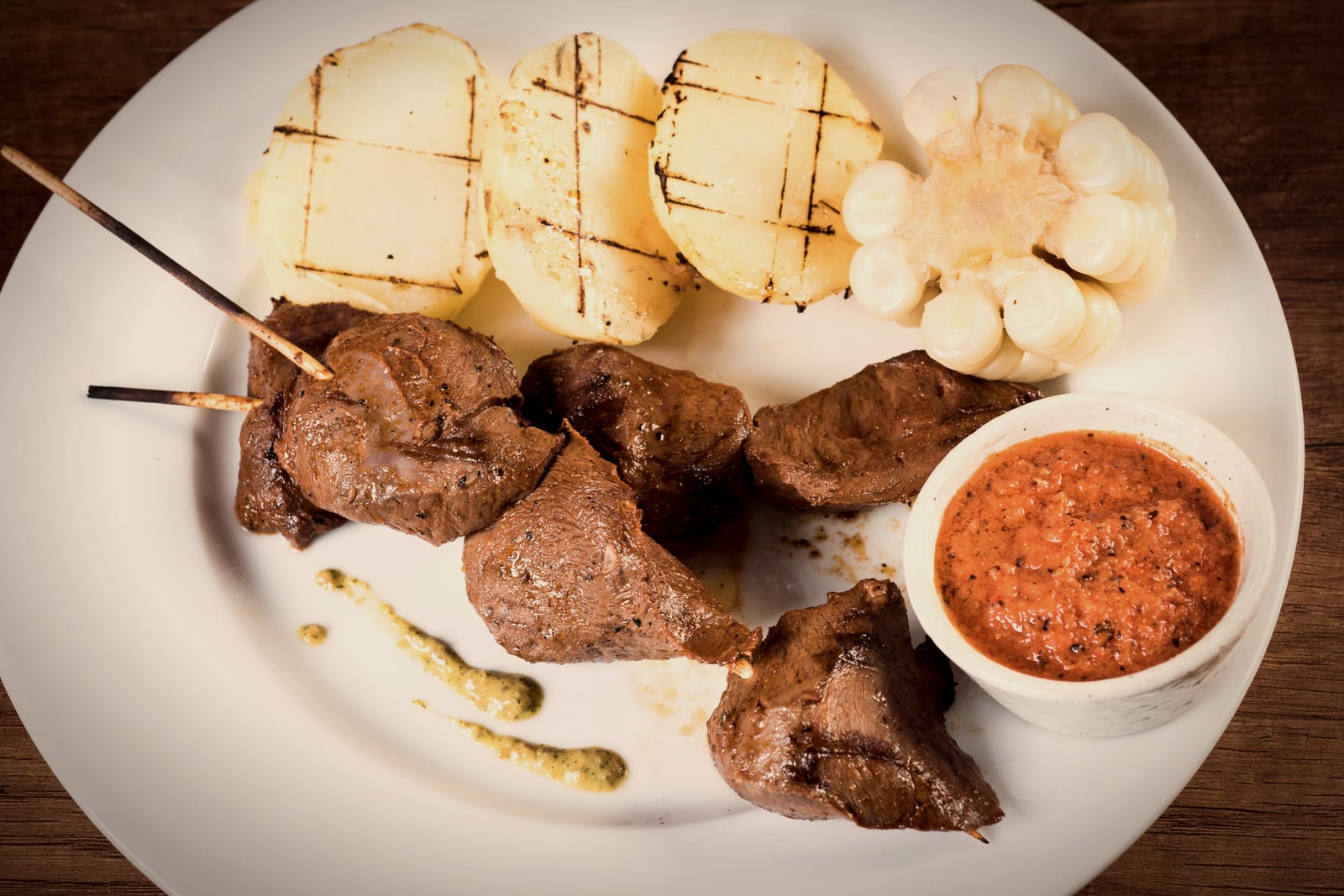
Beef heart on a cane skewer
An anticucho is a cane skewer threaded with three or four cubes of beef heart that have been marinated overnight in a paste of dried red ají panca chile, vinegar, garlic, cumin and oregano. The skewers are grilled over hot charcoal for only a few minutes, basted with the marinade, until charred at the edges and still juicy inside.
Heart is a working muscle, lean and dense, with a firm, even texture and a deep beefy flavour; it has little connective tissue, so it is tender when cooked briefly and rubbery when overcooked. In Lima, anticuchos are sold at night from street carts and in anticucherías, with boiled potato, a piece of corn on the cob and spicy sauce.
The Andes and colonial Lima
Skewered and grilled meat existed in the Andes before the Spanish conquest, and some writers derive the name from Quechua (anti, the eastern Andes, and kuchu, "cut"); the etymology is commonly repeated but not established. Llama and other meats are usually named as the pre-Hispanic form.
The dish as it is known today took shape in colonial Lima. The usual account attributes it to enslaved Africans and their descendants, who were given the offal that the households they served did not use, and who seasoned beef heart with chile and vinegar and grilled it. The story is part of Afro-Peruvian identity and is widely cited, although the documentary record is thin. By the 19th and 20th centuries the anticuchera, usually a woman grilling at a street stall, was a familiar figure in Lima, and anticuchos are traditionally sold during the October processions of the Señor de los Milagros.
Ingredients
| Ingredient | Amount | Note |
|---|---|---|
| Beef heart | 1 kg / 2.2 lb trimmed (about 1.4 kg / 3 lb whole) | fat, valves and membranes removed |
| Ají panca paste | 120 g / ½ cup | or 6 dried ají panca, soaked and blended |
| Red wine vinegar | 120 ml / ½ cup | or chicha de jora |
| Garlic | 8 cloves / 30 g / 1 oz | puréed |
| Ground cumin | 2 tsp | |
| Dried oregano | 1 tsp | |
| Salt, black pepper | 15 g / ½ oz salt; 1 tsp pepper | |
| Vegetable oil | 60 ml / ¼ cup | for the basting mixture |
| Cane or bamboo skewers | 18, about 25 cm / 10 in | soaked 30 min |
| Yellow or white potatoes | 6 (900 g / 2 lb) | boiled, then browned on the grill |
| Choclo (large-kernel Andean corn) | 3 cobs | boiled, halved |
| Lump charcoal | 3 kg / 6.5 lb |
Method
- Trim the heart: cut away the fat cap, the valves, the hard vessels and the thin membrane on the inner surfaces. Cut it into pieces about 4 × 3 cm and 1.5 cm thick / 1½ × 1¼ × ½ in.
- Mix the ají panca, vinegar, garlic, cumin, oregano, salt and pepper. Coat the heart and refrigerate for 4 to 12 hours.
- Thread three or four pieces on each skewer, flat, so they lie evenly on the grill. Mix the leftover marinade with the oil for basting.
- Light the charcoal and wait for a very hot, even bed of coals; the hand at grill height should bear only 2–3 seconds. See grilling over fire.
- Grill the skewers 2–3 minutes per side, basting them with the oil mixture once or twice, until the outside is lightly charred and the inside is just pink to medium, about 60–63 °C / 140–145 °F. Longer cooking makes heart tough and dry.
- Brown the boiled potatoes on the grill and serve at once, with the corn and sauce.
Tripe in Lima, mixed skewers in Chile
In Peru, pancita (tripe) and rachi (honeycomb tripe) are grilled the same way and sold alongside; chicken, fish and octopus anticuchos are modern restaurant versions. In Bolivia, anticuchos de corazón are a night street food in La Paz, Cochabamba and other cities, served with potato and a peanut and chile sauce (salsa de maní). In Chile, anticucho means any mixed meat skewer — beef, sausage, onion and pepper — and is a staple of the grills of the Fiestas Patrias in September.
Potato, choclo and ají
Anticuchos are served on their skewers, with boiled and grilled potato, choclo and a fresh chile sauce: ají de huacatay (with black mint) or rocoto sauce. A Peruvian salsa criolla of onion and lime is a common side. They are a starter in Peruvian restaurants and a full meal at street stalls, often followed by picarones, sweet-potato and squash fritters. Common mistakes: leaving membranes on the heart, cutting it too thin or too thick, a fire that is not hot enough, and overcooking.
Frequently asked questions
What are anticuchos made of?
Traditionally beef heart, marinated in ají panca chile, vinegar, cumin and garlic; tripe, chicken and fish versions also exist.
How long should anticuchos be grilled?
Two to three minutes per side over very hot charcoal; heart is best pink to medium and turns rubbery if overcooked.
Where do anticuchos come from?
From Peru. Skewered meat is pre-Hispanic in the Andes; the beef-heart anticucho is associated with Afro-Peruvian cooks of colonial Lima, though the documentation is limited.
Are Chilean anticuchos the same as Peruvian ones?
No. In Chile the word means a mixed skewer of beef, sausage and vegetables; in Peru and Bolivia it means marinated beef heart.
Sources
2
- McGee, Harold. On Food and Cooking: The Science and Lore of the Kitchen, rev. ed. New York: Scribner, 2004.
- Acurio, Gastón. Peru: The Cookbook. London: Phaidon, 2015.
Related