Main course · Japan, rare inside
Gyukatsu
Gyukatsu is a Japanese beef cutlet: a thick slice of whole-muscle beef coated in fine panko and deep-fried for about a minute, often finished by the diner on a small hot stone at the table. The fry is so hot and so short that the crust browns before heat reaches the centre, which stays rare.
At a glance
- Origin
- Japan; beef cutlet since the Meiji era, rare style from the 2010s
- Cut
- Whole-muscle sirloin, ribeye, rump or tenderloin, 2 cm / ¾ in
- Frying
- 60–90 s in oil at 190–200 °C / 375–390 °F
- Serves
- 4
- Time
- 30 min active, 50 min total
Tonkatsu's method, reversed
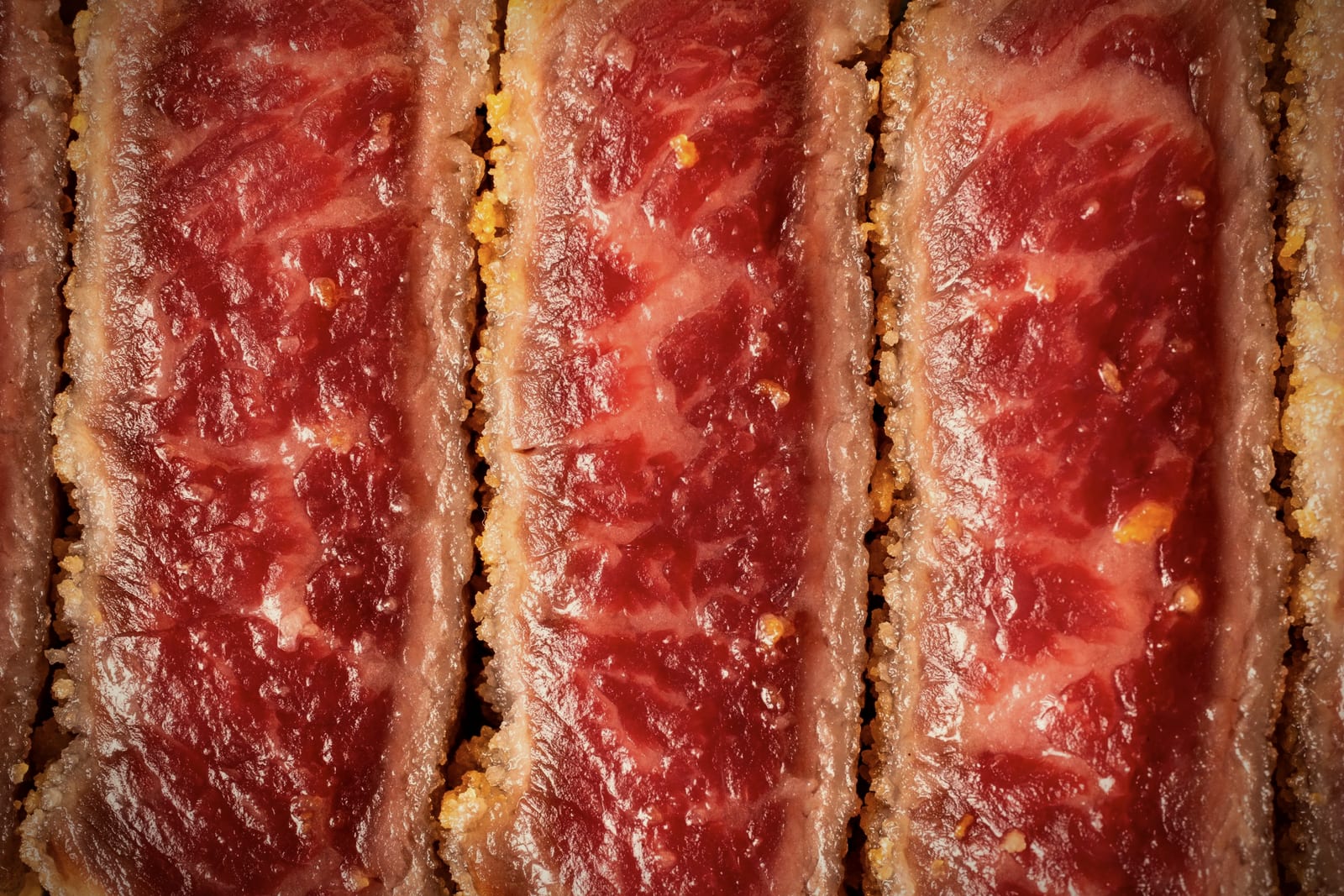
A gyukatsu set arrives sliced into strips, showing a thin golden crust around a red centre. Beside it there is usually a small stone, ceramic or iron plate heated over a burner, on which each strip can be seared a few seconds longer to the diner's preference. It is eaten with shredded cabbage, rice, miso soup and condiments such as wasabi and soy sauce, salt, or a sweet-sour sauce.
The technique borrows from tonkatsu, the pork cutlet, but reverses its goal: pork is fried until cooked through, while the beef is fried very hot and very briefly, so that the crust browns before heat reaches the centre. The coating insulates the meat and keeps its juices in.
From Kansai bifukatsu to Tokyo
Breaded, fried cutlets entered Japanese cooking in the Meiji era as part of yōshoku, Western-style food adapted to Japanese tastes. The beef version, bifukatsu, became a classic of Western-style restaurants in the Kansai region (Osaka, Kobe, Kyoto), usually cooked to medium or well done and served with a demi-glace or Worcestershire-type sauce. In eastern Japan, pork tonkatsu, popularized in Tokyo in the 1920s and 1930s, became the dominant cutlet.
The rare, panko-crusted gyukatsu with a personal hot stone spread from Tokyo in the mid-2010s through specialist restaurants and chains, and became popular with visitors to Japan; it is now found in many Asian cities. Exactly which restaurant introduced the format is not well documented.
Ingredients
| Ingredient | Amount | Note |
|---|---|---|
| Beef sirloin, ribeye, rump or tenderloin, whole muscle | 4 steaks, 150 g / 5 oz each | 2 cm / ¾ in thick, well chilled |
| Salt and black pepper | to taste | just before breading |
| Plain flour | 50 g / ⅓ cup | |
| Eggs | 2 | beaten with 1 tbsp water |
| Fine panko breadcrumbs | 100 g / 2 cups | crushed finer than for tonkatsu |
| Frying oil (rice bran or other neutral oil) | 1.5 litres / 6 cups | about 4 cm / 1½ in deep |
| Cabbage | ¼ head, about 250 g / 9 oz | shredded very fine, in iced water |
| Wasabi and soy sauce | to serve | |
| Mountain-pepper salt (sansho salt) or flaky salt | to serve | |
| Cooked rice (or barley rice, mugimeshi) | 800 g / about 5 cups | one bowl per diner |
| Grated yam (tororo) | 100 g / 3½ oz | optional, eaten over rice |
Method
- Keep the beef refrigerated until breading; a cold centre is what allows the inside to stay rare. Trim the outer fat and sinew, and pat the steaks dry.
- Season with salt and pepper. Dredge in flour and shake off the excess, dip in the beaten egg, then press firmly into the panko so that the coating is even and complete.
- Heat the oil to 190–200 °C / 375–390 °F; use a thermometer. Fry one or two steaks at a time for 60–90 seconds in total, turning once, until the crust is deep golden.
- Lift onto a rack and rest 1–2 minutes, so the crust stays crisp and the juices settle.
- Slice across the grain into strips about 1.5 cm / ⅝ in wide. The centre should be red and barely warm, with a thin cooked band under the crust.
- Serve with the cabbage, rice and condiments, and a hot stone or small grill. Each strip can be seared 5–20 seconds per side on the stone, from rare to medium.
Is rare gyukatsu safe?
Harmful bacteria such as E. coli O157 are found on the surface of beef, not inside an intact muscle. Frying at about 190 °C / 375 °F sterilizes the surface of a whole steak, so a rare centre carries a risk similar to a rare steak. The same reasoning appears in Japan's 2011 standard for beef served raw, issued after a fatal outbreak linked to raw beef: the outer layer must be heated to 60 °C / 140 °F for two minutes to a depth of 1 cm.
The reasoning fails when the surface has been pushed inside. Beef that has been needle-tenderized, injected with fat or marinade, or bonded from smaller pieces (sometimes sold as "processed" or "restructured" beef) can carry surface bacteria into the centre; Japanese authorities advise cooking such meat through, to 75 °C / 167 °F for one minute in the centre. For rare gyukatsu, only intact whole-muscle beef is suitable. People at higher risk can sear the strips on the stone until no longer red.
Wagyu sirloin, tongue, katsu sando
Restaurants vary the cut, from lean rump to marbled wagyu sirloin; some offer tongue or misuji (top blade) cutlets. The Kansai bifukatsu is cooked through and served with demi-glace, sometimes in a sandwich (katsu sando) or over rice with curry. Gyukatsu is also served as katsudon-style bowls or with a soft egg. Pork tonkatsu and chicken chikinkatsu follow the same breading but are always cooked through.
Some strips as they come, some on the stone
The set is eaten in stages: some strips as they come, some seared on the stone, with different condiments; the rice is often refilled. Common mistakes: frying beef at room temperature, which overcooks the centre; oil that is not hot enough, giving a greasy, pale crust; coarse panko, which falls off a short fry; slicing too soon, which loses the crust; and using tenderized or restructured beef for a rare cutlet.
Frequently asked questions
Is gyukatsu supposed to be raw inside?
It is served rare: the centre is red and barely warm. Diners can sear each strip on the hot stone to the doneness they prefer.
Is rare gyukatsu safe to eat?
With intact whole-muscle beef, frying sterilizes the surface, and the risk is similar to a rare steak. Tenderized, injected or restructured beef should be cooked through.
What is the difference between gyukatsu and tonkatsu?
Gyukatsu is beef fried very briefly and served rare; tonkatsu is pork, fried longer until cooked through.
What oil temperature is used for gyukatsu?
About 190–200 °C / 375–390 °F, for 60–90 seconds in total for a cutlet 2 cm / ¾ in thick.
Sources
4
- McGee, Harold. On Food and Cooking: The Science and Lore of the Kitchen, rev. ed. New York: Scribner, 2004.
- USDA Food Safety and Inspection Service. Safe Minimum Internal Temperature Chart. 2023. www.fsis.usda.gov/food-safety/safe-food-handling-and-preparation/food-safety-basics/safe-temperature-chart
- Ministry of Health, Labour and Welfare (Japan). Standards for raw beef for raw consumption (生食用食肉の規格基準), under the Food Sanitation Act. Tokyo, 2011.
- Cwiertka, Katarzyna J. Modern Japanese Cuisine: Food, Power and National Identity. London: Reaktion Books, 2006.
Related