Main course · Japan, the beef bowl
Gyudon
Gyudon, the Japanese beef bowl, is steamed rice topped with paper-thin beef and onion simmered in dashi, soy sauce and mirin; it grew from the Meiji-era beef pot into one of Japan's most common restaurant meals. The usual cut is fatty short plate, whose fat keeps the thin slices moist while the rice below absorbs the juices.
At a glance
- Origin
- Japan, Meiji era; Tokyo fish market, 1899
- Cut
- Short plate (bara), sliced 1.5–2 mm
- Simmering liquid
- Dashi, soy sauce, mirin, sake, sugar
- Serves
- 4
- Time
- 15 min active, 25 min total (with cooked rice)
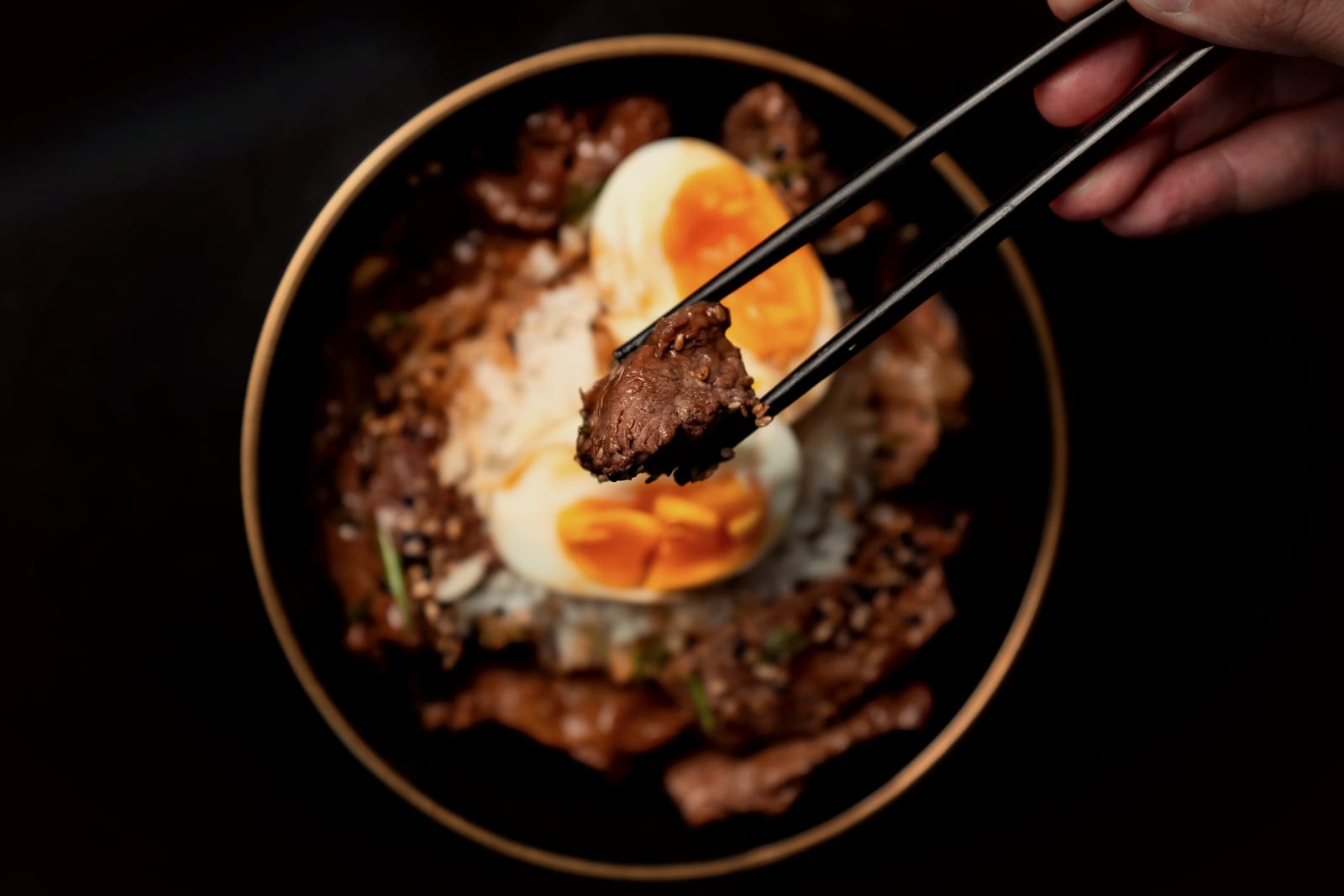
Fatty beef, sliced paper-thin
Gyū means beef and don is short for donburi, a deep bowl of rice with a topping. In gyudon, the topping is fatty beef cut paper-thin and simmered for a few minutes with sliced onion in a seasoned broth, so that the meat stays tender and the rice below absorbs the juices.
The usual cut is the short plate (bara), the fatty belly meat next to the short ribs; its fat keeps the thin slices moist through simmering and reheating. Chuck and brisket slices are also used at home. Restaurant chains have relied heavily on imported short plate, and the dish is closely tied to the beef trade.
From Nihonbashi market to the counter
Gyudon descends from the gyūnabe, the beef pot that became fashionable in Tokyo after meat-eating was officially encouraged in the early Meiji era (see sukiyaki). Serving the simmered beef over rice, as gyūmeshi or gyūdon, made it a quick, cheap meal for workers.
The Yoshinoya company dates its founding to 1899, when a shop serving beef bowls opened in the Nihonbashi fish market in Tokyo, a place where traders wanted to eat fast. After the Great Kantō earthquake of 1923 the market moved to Tsukiji, and the shop with it. From the late 1960s, chains turned gyudon into a standardized, very fast meal served at counters in a minute or two, at a low fixed price.
The dish's dependence on imported beef became visible in 2004: after a case of bovine spongiform encephalopathy (BSE) in the United States, Japan suspended imports of US beef, and the major chains stopped serving or changed their beef bowls until imports resumed.
Ingredients
| Ingredient | Amount | Note |
|---|---|---|
| Beef short plate (bara), thinly sliced | 400 g / 14 oz | 1.5–2 mm; chuck or brisket also work |
| Onion | 2 medium, about 300 g / 10½ oz | halved, sliced 5 mm / ¼ in |
| Dashi (kombu and bonito stock) | 300 ml / 1¼ cups | or water with instant dashi |
| Soy sauce | 60 ml / ¼ cup | |
| Mirin | 60 ml / ¼ cup | |
| Sake | 30 ml / 2 tbsp | |
| Sugar | 15–25 g / 1–2 tbsp | to taste |
| Fresh ginger | 10 g / ⅓ oz | grated or julienned; optional |
| Cooked Japanese short-grain rice | 800 g / about 5 cups | hot, about 200 g / 1¼ cups per bowl |
| Pickled red ginger (beni shōga) | to serve | |
| Shichimi tōgarashi (seven-spice chili) | to serve | |
| Eggs or onsen tamago | 4, optional | raw or soft-poached |
Method
- Cut any very long slices of beef into pieces of 5–7 cm / 2–3 in. Slice the onions.
- In a wide, shallow pan, bring the dashi, soy sauce, mirin, sake and sugar to a boil. Add the ginger, if using.
- Add the onion and simmer over medium heat for 5–7 minutes, until it is soft and translucent but still holds its shape.
- Add the beef, separating the slices with chopsticks so they do not cook in clumps. Skim the grey foam as it rises.
- Simmer 2–3 minutes, just until the beef is no longer pink. In a simmering liquid near 95 °C / 203 °F, slices this thin are cooked through in a minute or two; longer cooking only toughens and dries them.
- Fill the bowls with hot rice, spoon over the beef and onion with a few spoonfuls of the liquid, and serve at once with red ginger and shichimi; add an egg on top if desired.
Tsuyudaku, negidaku and an egg
Chain-restaurant ordering has its own vocabulary: tsuyudaku means extra broth, tsuyunuki little or none, and negidaku extra onion. Common versions add a raw or soft egg, grated cheese, kimchi or grated daikon with ponzu. The same simmered beef served on a plate, with rice on the side, is a gyū-sara set. Butadon uses pork, and oyakodon chicken and egg. In some regions, especially in the Kansai area, a version made with tender stewed beef tendon (suji) is common. Thicker, sukiyaki-style beef over rice is sold as gyū-suki-don.
Hot rice, miso soup, pickles
Gyudon is eaten as a single-bowl meal, often with miso soup and a small salad or pickles. The rice should be hot and slightly firm so it absorbs broth without turning mushy. Common mistakes: using lean beef, which dries and toughens; boiling the beef too long; adding the meat before the onion is soft; pouring too much broth, which soaks the rice; and slicing the beef too thick, which needs longer cooking than the dish allows.
Frequently asked questions
What cut of beef is used for gyudon?
Short plate (bara), the fatty belly meat next to the short ribs, sliced 1.5–2 mm thick. Thinly sliced chuck or brisket is a common substitute.
What is the sauce in gyudon made of?
Dashi, soy sauce, mirin, sake and sugar, in which onion and beef are simmered together; some recipes add ginger.
What is the difference between gyudon and sukiyaki?
Both use thin beef in a sweet soy seasoning, but sukiyaki is cooked at the table in an iron pan and dipped in raw egg, while gyudon is simmered with onion in dashi and served over rice.
What is beni shōga?
Ginger pickled in plum vinegar and coloured red, served on gyudon to cut the richness of the beef.
Sources
5
- McGee, Harold. On Food and Cooking: The Science and Lore of the Kitchen, rev. ed. New York: Scribner, 2004.
- Cwiertka, Katarzyna J. Modern Japanese Cuisine: Food, Power and National Identity. London: Reaktion Books, 2006.
- Andoh, Elizabeth. Washoku: Recipes from the Japanese Home Kitchen. Berkeley: Ten Speed Press, 2005.
- Hosking, Richard. A Dictionary of Japanese Food: Ingredients and Culture. Tokyo: Tuttle, 1996.
- Yoshinoya Holdings Co., Ltd. Company history (founding at the Nihonbashi fish market, 1899). Tokyo.
Related