Main course · Brazil, light salt
Carne de sol
Carne de sol is a beef of Northeast Brazil, salted lightly and air-dried for a day or less, so the surface firms while the inside stays moist and pink. Unlike charque or carne-seca it is not shelf-stable and is treated as fresh beef; it is eaten grilled or fried, classically with cassava and clarified butter.
At a glance
- Origin
- Northeast Brazil (sertão)
- Type
- Lightly salted, briefly air-dried beef; perishable
- Cure
- 12–24 h in the refrigerator, below 4 °C / 40 °F
- Serves
- 6
- Time
- 40 min active, about 1 day in total
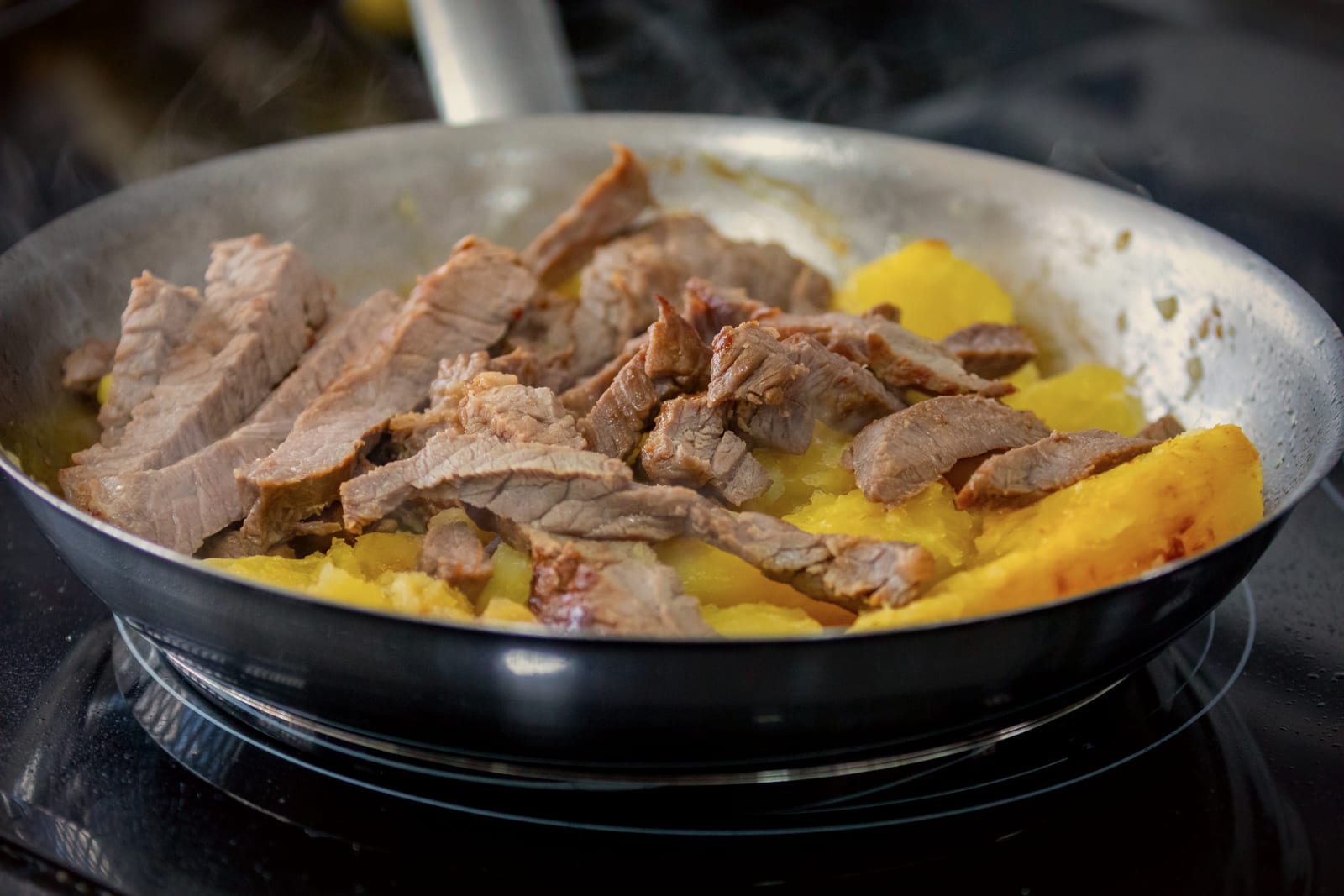
Salted, dried in the shade, still pink
Carne de sol ("sun meat") is beef cut into thick slabs or blankets, rubbed with salt and left for a day or less in a cool, airy, shaded place, so that the surface dries and firms while the inside stays moist and pink. The salt penetrates only partly. The result is tender, mildly salty meat with a concentrated flavour, closer to fresh beef than to dried beef.
Despite the name, traditional producers usually avoid direct sun, which would cook and harden the surface: the meat hangs in the shade, or outdoors at night, which is why it is also called carne de sereno ("night-dew meat") and carne do sertão. Lean, boneless pieces of the hindquarter are used, such as coxão mole (top round), alcatra (rump) and sometimes picanha or tenderloin.
The sertão and its three salted beefs
Carne de sol belongs to the sertão, the dry interior of Northeast Brazil, where cattle ranching spread from the 17th century. With no refrigeration and a hot, dry climate, salting was the way to keep beef for a few days. Luís da Câmara Cascudo's História da Alimentação no Brasil describes salted and dried meats as staples of the region's diet.
It is one of three related Brazilian salted beefs, often confused. Charque, an industrial product historically made in the far south and exported north, is wet-salted heavily, pressed in piles and dried in the sun for days; it is hard, very salty and keeps without refrigeration. Carne-seca (also jabá) is a similar heavily salted, sun-dried meat. Carne de sol is the lightest of the three: less salt, a short drying time and, as a result, a short life. The names vary from state to state, and some regions use them loosely.
Light salt slows spoilage, not pathogens
Salt preserves meat by drawing out water and dissolving into what remains, which lowers the water available to bacteria. In charque this effect is strong enough to make the meat stable at room temperature. In carne de sol it is not: the meat keeps a high moisture content and must be treated as fresh beef. As meat science texts such as Lawrie's Meat Science explain, light salting slows spoilage but does not stop the growth of pathogens.
For that reason modern recipes cure carne de sol in the refrigerator, below 4 °C / 40 °F, on a rack over a tray, uncovered, for 12–24 hours. The finished meat keeps a few days refrigerated, or can be frozen. It is cooked through or at least seared well on all surfaces, and it is not eaten raw. Outdoor drying is a regional practice that depends on a dry climate, clean conditions and quick consumption; it is not recommended in humid places or near insects.
Ingredients
| Ingredient | Amount | Note |
|---|---|---|
| Beef, lean and boneless (top round or rump) | 1.5 kg / 3.3 lb | one piece, fat trimmed |
| Coarse salt | about 75 g / ⅓ cup | about 5% of the meat weight |
| Cassava (macaxeira, aipim) | 1 kg / 2.2 lb | peeled, boiled, then fried or served boiled |
| Manteiga de garrafa (clarified butter) | 60 ml / ¼ cup | or ghee |
| Onion | 2, about 300 g / 10½ oz | sliced in rings |
| Coalho cheese | 300 g / 10½ oz | optional, grilled |
Method
- Open the beef into a thick blanket by cutting it lengthwise without separating it, to an even thickness of about 3–4 cm / 1¼–1½ in. Cut shallow slits on the surface so the salt can enter.
- Rub the salt evenly into all surfaces. Lay the meat on a rack over a tray and refrigerate, uncovered, below 4 °C / 40 °F, for 12–24 hours, turning it once. It will release liquid and the surface will turn darker and dry to the touch.
- Before cooking, taste a small piece seared in a pan. If it is too salty, soak the meat in cold water in the refrigerator for 1–2 hours, changing the water once, then pat it dry. Some cooks soak it in milk.
- Cut the meat into steaks or cubes of about 3 cm / 1¼ in. Grill over hot embers or sear in a very hot pan with a little clarified butter until browned on all sides and cooked to at least medium, about 4–6 minutes for cubes.
- Fry the onion rings in the same fat until soft and golden and spoon them over the meat.
- Serve with the cassava, boiled until tender and then fried until crisp, drizzled with manteiga de garrafa.
Paçoca, arrumadinho, baião de dois
Paçoca de carne de sol pounds the fried, shredded meat with cassava flour and onion in a wooden mortar (pilão). Arrumadinho arranges cubes of carne de sol with fava or green beans, vinagrete and farofa. Carne de sol is also served with baião de dois (rice cooked with beans and cheese), with pumpkin puree, or as a filling for tapioca crepes. In the south, where charque dominates, the closest dish is arroz de carreteiro, rice cooked with charque. Unlike the churrasco, it is a food of the household and the roadside restaurant.
On a hot iron plate, with cassava
Carne de sol is a main course, usually served on a hot iron or clay plate with the cassava, onions, grilled coalho cheese, rice and beans, and pirão de leite (a milk and cassava-flour porridge). Common mistakes: drying the meat in the sun, which hardens the surface; leaving it out of the refrigerator in a warm, humid kitchen; over-salting, which makes the meat taste like charque; cooking it slowly until grey and dry, since lean cuts toughen; and storing it for weeks as if it were shelf-stable.
Frequently asked questions
What is the difference between carne de sol, charque and carne-seca?
Carne de sol is lightly salted and dried for less than a day, so it stays moist and perishable. Charque and carne-seca are heavily salted and sun-dried for days, hard and shelf-stable.
Is carne de sol dried in the sun?
Usually not directly: traditional producers dry it in the shade or overnight, and modern recipes cure it uncovered in the refrigerator.
Does carne de sol need to be refrigerated?
Yes. Its light cure does not make it stable at room temperature; it keeps a few days refrigerated, or longer frozen.
How is carne de sol eaten?
Grilled or fried in clarified butter, with cassava, onions, coalho cheese, rice and beans, or pounded with cassava flour as paçoca.
Sources
4
- Toldrá, Fidel (ed.). Lawrie's Meat Science, 8th ed. Duxford: Woodhead, 2017.
- McGee, Harold. On Food and Cooking: The Science and Lore of the Kitchen, rev. ed. New York: Scribner, 2004.
- Brasil, Ministério da Agricultura, SIPA. Portaria nº 5, de 8 de novembro de 1988 — Padronização de cortes de carne bovina.
- Câmara Cascudo, Luís da. História da Alimentação no Brasil. São Paulo: Companhia Editora Nacional, 1967.
Related