Main course · Russia, 1871
Beef Stroganoff
Beef Stroganoff is a Russian dish of thin strips of tender beef seared quickly and bound in a sauce of mustard and smetana (sour cream), first printed in the 1871 edition of Elena Molokhovets' cookbook. A minute or two in very hot fat keeps the strips pink; longer cooking toughens them.
At a glance
- Origin
- Russia, 19th century
- First printed
- Molokhovets, 1871 edition
- Cut
- Tenderloin or striploin, in strips
- Sauce
- Mustard and smetana (sour cream)
- Serves
- 4
- Time
- 40 min
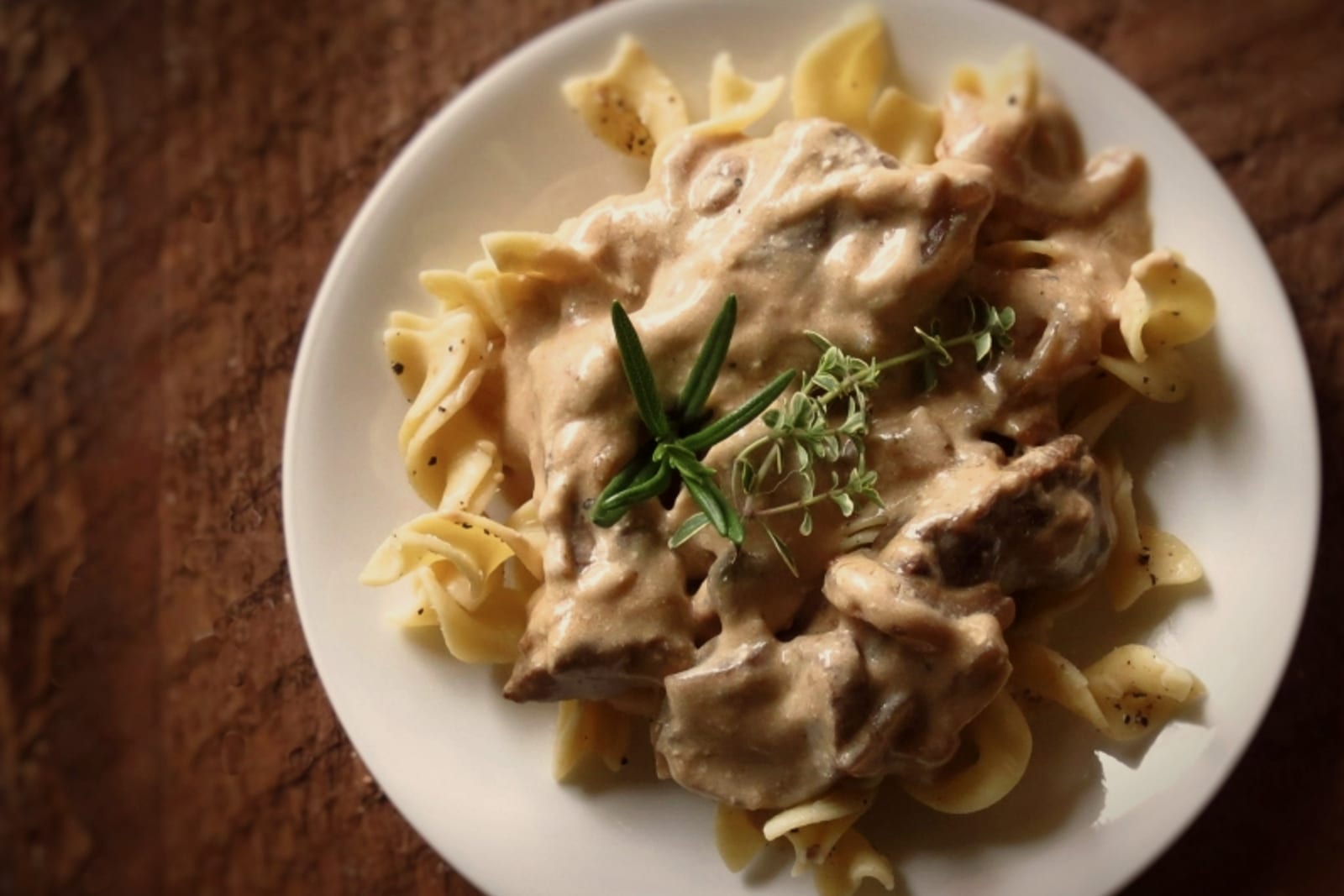
A quick sauté, not a stew
Stroganoff is a quick sauté, not a stew. A tender cut — usually tenderloin or striploin — is cut across the grain into strips about 1 cm / ½ in thick, seared in very hot fat for a minute or two, and finished in a sauce of stock, mustard and smetana, the cultured cream of Russian cooking. The meat should stay pink and juicy; long cooking toughens it.
In Russian the dish is called befstroganov (бефстроганов) or govyadina po-stroganovski, "beef in the Stroganov manner". Onions and mushrooms, now part of most versions, were added later.
Molokhovets, 1871, and a disputed count
The earliest known printed recipe is in the 1871 edition of Elena Molokhovets' A Gift to Young Housewives (Podarok molodym khozyaykam), the most widely used Russian household cookbook of the period; it is not in the first edition of 1861. Her "beef Stroganov with mustard" combines small pieces of beef, a roux-thickened stock with mustard, and sour cream, with no onions or mushrooms. Joyce Toomre's annotated English translation, Classic Russian Cooking (1992), discusses the recipe.
The name refers to the Stroganovs, a wealthy noble family, but which member is honored is disputed: stories credit a cook in the household of Count Pavel Stroganov or of Count Alexander Grigorievich Stroganov, and none is documented. The tale of a French chef inventing it for a cooking competition in 1891 appears after Molokhovets' recipe was already in print, so it cannot be the origin.
Russian émigrés spread the dish after 1917, and by the mid-20th century it was a fixture of restaurant and home cooking in the United States, Scandinavia, China, Brazil and elsewhere, each place changing it.
Ingredients
| Ingredient | Amount | Note |
|---|---|---|
| Beef tenderloin or striploin | 600 g / 1.3 lb | trimmed, in strips 5 × 1 cm / 2 × ½ in |
| Onion | 1, about 150 g / 5 oz | thinly sliced |
| Mushrooms | 250 g / 9 oz | sliced; optional in the older form |
| Butter | 40 g / 1½ oz | divided |
| Neutral oil | 1 tbsp / 15 ml | |
| Plain flour | 1 tbsp / 8 g | |
| Beef stock | 250 ml / 1 cup | |
| Mustard | 1–2 tsp | Russian or Dijon |
| Smetana or full-fat sour cream | 200 g / ¾ cup | at room temperature |
| Salt, black pepper | to taste | |
| Dill or parsley | a small handful | chopped, to finish |
Method
- Cut the beef across the grain into strips, pat dry and keep cold until the last moment. Season just before cooking.
- Melt half the butter in a wide pan and soften the onion over medium heat, about 8 minutes. Add the mushrooms and cook until their liquid evaporates and they brown. Transfer to a plate.
- Sprinkle the flour into the pan, stir for a minute, then whisk in the stock and the mustard. Simmer until slightly thickened, 2–3 minutes, and pour into a bowl.
- Wipe the pan, heat the oil and remaining butter until very hot and sear the beef in two or three batches, 60–90 seconds per batch, so it browns outside and stays pink inside. Do not crowd the pan.
- Return the onion, mushrooms and sauce to the pan with the beef. Take the pan off the heat and stir in the smetana; warm gently without boiling, below about 80 °C / 175 °F, or the cream may split.
- Adjust the salt and pepper and finish with dill or parsley.
Straw potatoes, noodles, estrogonofe
In Russia and the former Soviet Union it is commonly served with mashed potatoes or with kartofel' solomkoy, very thin fried potato sticks, and the sauce often includes a little tomato paste. In the United States the mid-century version, made with mushrooms and sometimes with cheaper cuts or ground beef, is served over buttered egg noodles. Sweden has korv Stroganoff, made with sliced sausage, tomato and cream. In Brazil, estrogonofe is a household staple, frequently made with chicken, cream and ketchup, served with rice and crisp batata palha. In Japan, a similar beef and onion dish in demi-glace sauce, hayashi rice, is sometimes compared to it but has a separate history.
At once, with pickled cucumbers
Serve immediately, spooned over mashed potatoes, rice, noodles or straw potatoes, with pickled cucumbers on the side in the Russian way. Common mistakes: using a stewing cut and cooking it briefly, which leaves it chewy; crowding the pan, so the strips boil grey; boiling the sauce after the sour cream goes in, which curdles it; and cooking the beef in the sauce for long, which turns tender strips tough.
Frequently asked questions
Where does beef Stroganoff come from?
From 19th-century Russia. The earliest known printed recipe is in the 1871 edition of Elena Molokhovets' household cookbook; the name refers to the noble Stroganov family.
What cut of beef is used for Stroganoff?
A tender, quick-cooking cut such as tenderloin or striploin, cut across the grain into thin strips.
Why does Stroganoff sauce curdle?
Sour cream splits when it boils. Add it off the heat and warm the sauce gently.
Does traditional beef Stroganoff have mushrooms?
The earliest printed version has none; onions and mushrooms became standard later, especially outside Russia.
Sources
4
- McGee, Harold. On Food and Cooking: The Science and Lore of the Kitchen, rev. ed. New York: Scribner, 2004.
- Molokhovets, Elena. Podarok molodym khozyaykam [A Gift to Young Housewives]. St Petersburg, 1861; 1871 edition.
- Toomre, Joyce (trans. and ed.). Classic Russian Cooking: Elena Molokhovets' A Gift to Young Housewives. Bloomington: Indiana University Press, 1992.
- Davidson, Alan. The Oxford Companion to Food. Oxford: Oxford University Press, 1999.
Related