Main course · Smoke, then steam
Pastrami
Pastrami is beef, traditionally navel or brisket, brine-cured with salt and nitrite, crusted with coarse black pepper and coriander, smoked and then steamed; it is the signature meat of the New York Jewish deli and descends from the Romanian pastramă. The cure turns the meat pink and seasons it through; the final steaming, not the smoke, is what makes it tender.
At a glance
- Origin
- Romania (pastramă); New York delis (beef version)
- Cut
- Navel (plate) or brisket
- Process
- Brine-cure, spice rub, smoke, steam
- Smoke
- 107–121 °C / 225–250 °F to 68–74 °C / 155–165 °F inside
- Time
- About 7 days curing, 1 day cooking
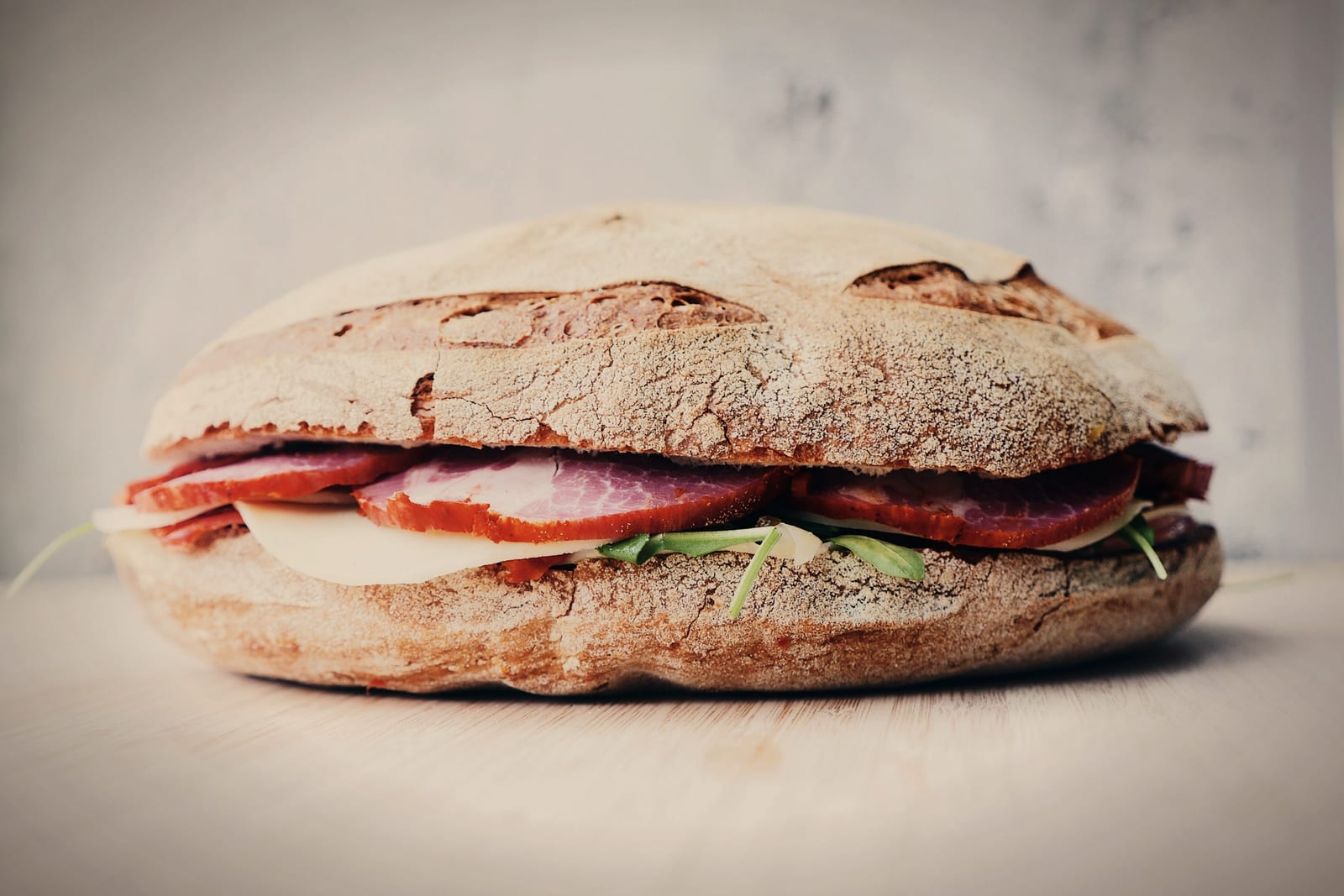
Corned beef, then pepper and smoke
Pastrami begins exactly like corned beef: a fatty cut of beef cured for about a week in a brine of salt, sugar, spices and sodium nitrite, which turns the meat pink and seasons it through. Then it diverges. The cured meat is rinsed, crusted with coarsely cracked black pepper and coriander seed, smoked for several hours, and finally steamed until the connective tissue has softened. It is served hot and sliced, most famously piled high on rye bread.
The classic New York cut is the navel, the fatty, fibrous lower part of the plate below the ribs, whose layers of fat keep the meat moist during smoking and steaming. Many delis and most home cooks use brisket, which is easier to find; the fattier point gives a result closer to navel than the lean flat.
From Romania to the Lower East Side
In Romania and Moldova, pastramă is a cured, seasoned and dried or smoked meat, historically made from mutton, goat, goose or pork rather than beef. The word is generally connected with the Turkish pastırma, an air-dried, spice-coated beef of Ottoman cuisine, from a root meaning 'to press'. The English spelling 'pastrami' is often explained as an Americanised form modelled on 'salami'.
Jewish immigrants from Romania and Bessarabia brought the method to New York in the late 19th century, where beef was cheap and abundant, and the kosher butcher shops and delicatessens of the Lower East Side turned it into a beef product. A widely repeated story credits a butcher named Sussman Volk with selling pastrami sandwiches in the 1880s, though it rests on family tradition. Katz's Delicatessen, founded in 1888 on the Lower East Side, is among the oldest delis still serving it. Gil Marks's Encyclopedia of Jewish Food and David Sax's Save the Deli trace how the delicatessen spread through North American cities in the first half of the 20th century and declined after it, while pastrami itself became a mainstream American food.
Ingredients
| Ingredient | Amount | Note |
|---|---|---|
| Beef navel or brisket | 2.5 kg / 5.5 lb | brisket point or whole brisket; keep the fat |
| Water | 4 L / 1 US gal | for the brine |
| Coarse salt | 200 g / 7 oz | not iodised |
| Curing salt #1 (Prague powder #1) | 20 g / 0.7 oz | 6.25 % sodium nitrite; weighed |
| Brown sugar | 100 g / 3.5 oz | for the brine |
| Pickling spice | 20 g / 0.7 oz | for the brine |
| Garlic | 4 cloves, 15 g / ½ oz | crushed, for the brine |
| Black peppercorns | 30 g / 1 oz | coarsely cracked, for the rub |
| Coriander seed | 30 g / 1 oz | coarsely cracked, for the rub |
| Hardwood for smoking | 2–4 kg / 4.5–9 lb | oak, hickory or fruit wood, or chunks for a smoker |
Method
- Dissolve the salt, sugar, pickling spice and garlic in 1 L / 1 qt of hot water, add the remaining cold water and the curing salt, and chill the brine below 4 °C / 40 °F.
- Submerge the beef, weigh it down and refrigerate at 1–4 °C / 34–39 °F for 5–7 days, turning daily. Thick pieces can be injected with about 10 % of their weight in brine.
- Rinse the beef and soak it in fresh cold water for 1–2 hours to remove excess surface salt. Pat it dry.
- Crack the peppercorns and coriander coarsely, mix them, and press the mixture firmly onto every surface.
- Smoke at 107–121 °C / 225–250 °F until the centre reaches 68–74 °C / 155–165 °F, usually 5–7 hours, by which time a dark, firm crust has formed.
- Optionally cool the meat and refrigerate it overnight, as many delis do; cold pastrami holds its shape and its spice crust better.
- Steam the pastrami on a rack over simmering water, covered, for 2–3 hours, until a probe slides in with little resistance, usually around 90–95 °C / 195–203 °F at the centre.
- Slice by hand across the grain, 3–6 mm / ⅛–¼ in thick, and serve hot.
Montreal smoked meat and others
Montreal smoked meat. Montreal's delis, of which Schwartz's (opened in 1928) is the best known, make a cousin from brisket: the meat is dry-cured with a heavily spiced, pepper- and garlic-forward mixture, smoked and steamed, and served on rye with yellow mustard. It is usually less sweet than New York pastrami.
Other versions. Some barbecue cooks treat pastrami as a smoked brisket with a light cure and finish it in the pit instead of steaming it; the method is closer to Texas brisket. Turkey and beef-cheek pastrami are modern variations. In Romania, pastramă made from mutton, goose or pork is still eaten, often fried or grilled, and is a different product from the deli meat.
Hot, hand-sliced, on rye
The New York deli serves pastrami hot, hand-sliced and stacked on rye bread with spicy brown mustard, with sour or half-sour pickles on the side and, traditionally, no butter, cheese or mayonnaise, in keeping with kosher rules against mixing meat and dairy. Customers often specify lean or fatty. Pastrami also appears in the Reuben in place of corned beef, in hash, and in pastrami-and-eggs.
Common mistakes. Skipping the soak, which leaves the outer layer very salty. Using fine pepper, which forms a paste instead of a crust. Slicing it cold and thin with a machine, which loses the texture of hand-cut slices. Smoking it to full tenderness, which dries the meat; the final steaming is what makes it tender and juicy.
Frequently asked questions
What cut of beef is pastrami?
Traditionally the navel, the fatty lower part of the plate; brisket, especially the fattier point, is the common alternative.
What is the difference between pastrami and corned beef?
Both are cured with salt and nitrite. Corned beef is simmered in water; pastrami is coated in pepper and coriander, smoked and steamed.
Where does pastrami come from?
From the Romanian pastramă, brought to New York by Jewish immigrants from Romania and Bessarabia in the late 19th century and remade there with beef.
Why is pastrami steamed?
Smoking flavours the meat and sets the crust; steaming then softens the remaining connective tissue and keeps the slices moist.
Sources
4
- McGee, Harold. On Food and Cooking: The Science and Lore of the Kitchen, rev. ed. New York: Scribner, 2004.
- Ruhlman, Michael; Polcyn, Brian. Charcuterie: The Craft of Salting, Smoking, and Curing. New York: W. W. Norton, 2005.
- Marks, Gil. Encyclopedia of Jewish Food. Hoboken: John Wiley & Sons, 2010.
- Sax, David. Save the Deli: In Search of Perfect Pastrami, Crusty Rye, and the Heart of Jewish Delicatessen. Boston: Houghton Mifflin Harcourt, 2009.
Related