Sandwich · Thick or smashed
Hamburger
A hamburger is a patty of ground beef, cooked on a griddle or grill and served in a soft bun with condiments, a sandwich of disputed American origin from the late 19th century. Chuck with about 20 % fat keeps the patty moist; pressed thin on a very hot griddle, most of its surface turns to crust.
At a glance
- Origin
- United States, late 19th century (disputed)
- Meat
- Ground chuck, about 80 % lean / 20 % fat
- Safe internal temp.
- 71 °C / 160 °F (USDA FSIS)
- Patty
- 170 g / 6 oz thick, or 2 × 85 g / 3 oz smashed
- Time
- 20 min active, 30 min total; serves 4
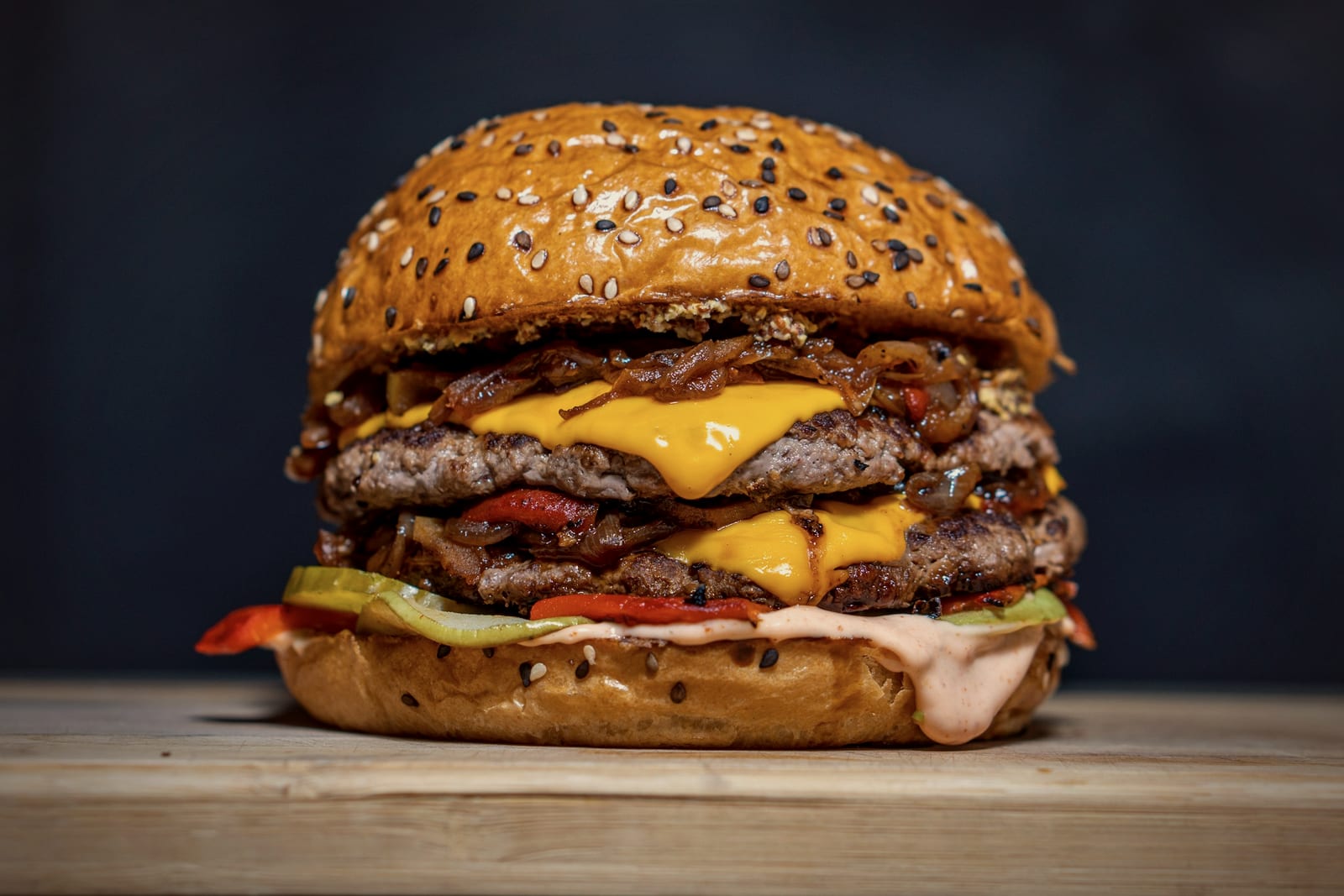
Ground beef, not a cut
The hamburger is defined by ground beef, not by a cut: the meat is minced, shaped into a flat round patty, seasoned on the outside and cooked quickly over high heat, then placed in a round bun. Cheese makes it a cheeseburger. The usual blend is beef chuck with about 20 % fat, which keeps the patty moist and carries flavor; some cooks add brisket or short rib for richness.
Two styles dominate. The thick patty, about 2 cm / ¾ in, is cooked like a small steak and judged by its juiciness. The smash patty is a ball of meat pressed thin onto a very hot griddle, where most of its surface becomes a brown, crisp crust through the Maillard reaction.
The Hamburg steak and many claimants
The name comes from Hamburg, Germany, and from the Hamburg steak, a seasoned patty of chopped beef that appeared on American menus in the 19th century, partly with German immigration. Who first put it in a bun is unknown. Several places claim it, and none has documentation that settles the question.
The best-known claims include Charlie Nagreen, said to have flattened meatballs into sandwiches at a fair in Seymour, Wisconsin, in 1885; the Menches brothers at a fair in Hamburg, New York, the same year; Fletcher Davis of Athens, Texas, said to have served them in the 1880s or 1890s; and Louis' Lunch in New Haven, Connecticut, which dates its sandwich to 1900, though it is served on toast rather than a bun. Food historian Andrew F. Smith, in Hamburger: A Global History, treats all of them as unproven. What is clear is that lunch counters, fairs and, from the 1920s, fast-food chains made the hamburger a national, then global, dish.
Ingredients
| Ingredient | Amount | Note |
|---|---|---|
| Ground beef chuck, 80/20 | 680 g / 1.5 lb | kept very cold; 4 thick or 8 smash patties |
| Salt | about 6 g / 1 tsp | on the outside, just before cooking |
| Black pepper | ½ tsp | freshly ground |
| Soft buns (potato, brioche or white) | 4 | split |
| Butter | 15 g / 1 tbsp | to toast the buns |
| American or cheddar cheese | 4 slices, about 85 g / 3 oz | optional |
| Onion | 1 small, about 100 g / 3½ oz | thin rings, or very thin slices for smash |
| Lettuce, tomato, dill pickles | to taste | |
| Ketchup, mustard, mayonnaise | to taste |
Method
- Keep the meat cold and handle it as little as possible. For thick burgers, shape four loose patties of 170 g / 6 oz, about 2 cm / ¾ in thick and slightly wider than the bun, with a shallow dimple in the centre so they do not dome. For smash burgers, form eight loose balls of 85 g / 3 oz.
- Toast the cut sides of the buns in butter on the griddle or a pan and set them aside.
- Thick patties: heat a cast-iron pan, griddle or grill to high. Salt and pepper the outside of the patties just before cooking. Cook 3–5 minutes per side without pressing them, until the centre reaches 71 °C / 160 °F on an instant-read thermometer.
- Smash patties: heat a heavy griddle or steel until very hot, about 230 °C / 450 °F at the surface. Set a ball down, press it firmly with a sturdy spatula to about 6 mm / ¼ in within the first 30 seconds, then season. Cook about 2 minutes until the edges are deep brown, scrape under the crust, flip, and cook 30–60 seconds more.
- Lay the cheese on the patties during the last minute and cover briefly to melt it.
- Assemble at once: bottom bun, sauce, patty (two for smash burgers), onion, pickles, lettuce, tomato and top bun.
Grinding moves bacteria inside: 71 °C
A whole steak is contaminated, if at all, only on its surface, which searing sterilizes. Grinding spreads surface bacteria such as E. coli O157:H7 through the whole patty, so the centre must be cooked too. The USDA Food Safety and Inspection Service recommends cooking ground beef to 71 °C / 160 °F, measured with a thermometer; color is not a reliable sign, because a patty can turn brown before it is safe or stay pink after it is. The same logic is why steak tartare is cut from a whole piece and never made from pre-ground beef.
In US labeling, both "ground beef" and "hamburger" may contain no more than 30 % fat; "hamburger" may include added beef fat, while "ground beef" may not. Restaurants that serve burgers cooked to a lower temperature on request are expected, under the FDA Food Code, to inform customers of the risk.
Slider, Juicy Lucy, onion burger
The slider is a small, thin burger steamed on onions, the format of early chains in the 1920s. The Oklahoma onion burger presses thinly sliced onion into the patty on the griddle. The Minneapolis Juicy Lucy hides cheese inside the patty, and two local bars dispute its invention. Wisconsin serves the butter burger, New Mexico the green chile cheeseburger, and the patty melt puts the patty and onions between griddled rye bread. Outside the United States the hamburger has taken local forms, such as the Japanese hambāgu, a Hamburg steak served without a bun.
Eaten at once, with fries and pickles
Hamburgers are eaten immediately, with French fries, onion rings or coleslaw, and pickles. Condiments vary by region and taste; American cheese is used for its smooth melt rather than its flavor.
Common mistakes. Kneading the meat or mixing salt into it, which gives a dense, sausage-like texture. Pressing a thick patty in the pan, which squeezes out its juice. Using lean beef (90 % or more), which turns dry. A pan that is not hot enough, which steams the meat grey instead of browning it. Judging doneness by color instead of a thermometer. A bun too firm or too large for the patty.
Frequently asked questions
What temperature should a hamburger be cooked to?
The USDA recommends 71 °C / 160 °F in the centre for ground beef, checked with a thermometer, because grinding spreads surface bacteria through the meat.
What is the best fat ratio for burgers?
About 80 % lean and 20 % fat is the usual standard: leaner blends tend to dry out, fattier ones shrink and flare.
Who invented the hamburger?
No one is proven. Seymour (Wisconsin), Hamburg (New York), Athens (Texas) and New Haven (Connecticut) all claim it; the name comes from the Hamburg steak.
What is a smash burger?
A ball of ground beef pressed thin onto a very hot griddle so that most of its surface forms a crisp brown crust; it cooks through in about 3 minutes.
Sources
5
- USDA Food Safety and Inspection Service. Safe Minimum Internal Temperature Chart. 2023. www.fsis.usda.gov/food-safety/safe-food-handling-and-preparation/food-safety-basics/safe-temperature-chart
- McGee, Harold. On Food and Cooking: The Science and Lore of the Kitchen, rev. ed. New York: Scribner, 2004.
- Smith, Andrew F. Hamburger: A Global History. London: Reaktion Books, 2008.
- López-Alt, J. Kenji. The Food Lab: Better Home Cooking Through Science. New York: W. W. Norton, 2015.
- U.S. Code of Federal Regulations, Title 9, §319.15, Miscellaneous beef products: (a) Chopped beef, ground beef; (b) Hamburger.
Related